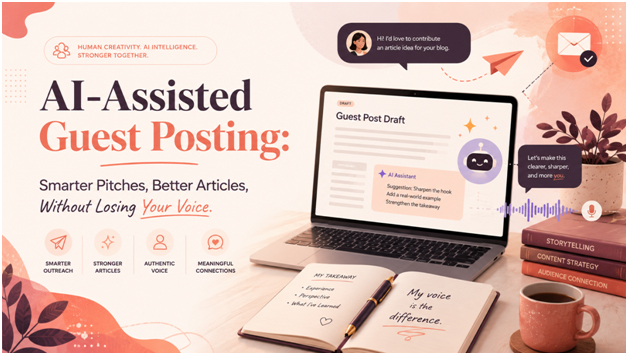

Everyone is using AI for content now. The question is no longer whether to use it, but how to use it in a way that makes your guest posts sharper, your pitches faster, and your editorial relationships stronger – without producing the kind of hollow, personality-free writing that editors can spot in the first paragraph. This article draws the line between AI as a useful tool and AI as a crutch. It also gives you a workflow that actually works.
The first time I used an AI tool to help write a guest post pitch, I felt vaguely like I was cheating. I typed in the publication name, the article idea, and a few notes about my angle, and got back a three-paragraph pitch that was… fine. Grammatically correct. Logically structured. Completely devoid of any sign that a human being with a specific point of view had written it. I rewrote the whole thing from scratch and sent that version instead. It got accepted.
That experience set the tone for how I have used AI tools ever since. Not as a ghostwriter. Not as a replacement for the thinking that makes a piece worth reading. As a very fast assistant that handles the parts of writing that do not require a human mind, so the human mind can spend more time on the parts that do.
If you have been wondering how to bring AI into your guest posting workflow without producing articles that read like they were assembled by a machine – which editors absolutely notice, by the way, even when they cannot name exactly what is off – this is the article I wish someone had written for me two years ago.
Where AI Actually Helps in a Guest Posting Workflow
Let me be specific about this, because most articles about AI and content creation wave at the topic vaguely without saying anything concrete. Here are the places in a guest posting workflow where AI genuinely saves time and makes output better:
Research compression
The part of pitching that takes the longest is reading enough of a publication to find a genuine content gap. AI tools with live search capability can surface a publication’s recent coverage, identify recurring themes, and flag underexplored angles in a fraction of the time manual research takes. I use this regularly. It does not replace reading the publication – you still need to do that – but it surfaces the patterns faster.
Outline generation
A strong guest post has a clear shape before a single paragraph is written. AI is genuinely good at generating an outline from a topic and angle. Not because the outline is always right – it usually is not, and I change about half of it – but because having something to react to is faster than building from nothing. Disagreeing with a bad outline is faster than staring at a blank document.
Headline variations
Writing a single strong headline is harder than it looks. Generating twenty headline options in thirty seconds and picking the best one is one of the most efficient things AI can do for a writer. I use this for pitch subject lines as well as article titles. The AI rarely produces the exact line I end up using, but it almost always produces one that I can rewrite into something better.
Editing passes
Pasting a finished draft into an AI tool and asking it to flag sentences that are unclear, overlong, or passive is a useful final check. It is not a replacement for reading your own work out loud, but it catches things that a tired eye misses after three hours of drafting.
Meta descriptions and author bios
Both of these are important, both are frequently written in five distracted minutes at the end of a session, and both are exactly the kind of structured, format-constrained writing that AI does well. Hand these off entirely. Spend the saved time on the article itself.
Where AI Makes Guest Posts Worse, Not Better
This is the part most AI productivity articles skip, and it is the part that matters most for guest posting specifically.
Editors who read a lot of guest submissions have developed a specific sensitivity to AI-generated prose. It is not always about factual errors or obvious tells like ‘certainly’ and ‘delve.’ It is about a quality of flatness. AI writing is grammatically confident but experientially empty. It describes what things are without the texture of someone who has actually encountered them. It argues a position without the slight roughness of a mind that arrived at that position by thinking it through rather than pattern-matching to training data.
In guest posting, that flatness is fatal. An editor who reads fifty pitches a week and receives one that sounds like a human being with a specific perspective and one that sounds like fluent content generation will always, without exception, be more interested in the first one. Your perspective is the entire reason anyone would want to publish you rather than generating the article themselves.
The specific places where AI consistently makes guest posts worse: the introduction, where voice is established in the first three sentences; any section that depends on a personal example or lived experience; the conclusion, where the reader needs to feel that a real person brought them somewhere worth arriving; and the transitions between sections, which in AI writing tend to be mechanical rather than earned.
Write all of those yourself. Every time. No exceptions. Use AI for everything around them.
The Workflow That Actually Works: A Practical System
After a lot of trial and error, here is the workflow I now use for every guest post I write. It is not complicated. The whole point is that it is not complicated.
Step 1 – Research the publication yourself first.
Spend twenty minutes reading. Find a real gap. This part cannot be delegated to AI because the gap you find needs to come from genuine attention, not keyword pattern-matching. AI can support this step but cannot replace the human judgement that identifies a meaningful angle.
Step 2 – Use AI to stress-test your angle.
Once you have an idea, paste it into an AI tool and ask: what are the strongest objections to this argument? What has already been written about this? What would make this more specific or surprising? The responses will be uneven, but the process surfaces blind spots you might not have found on your own.
Step 3 – Generate an outline, then break it.
Ask for an outline. Read it. Delete the sections that feel generic. Add the ones only you would write. Reorder until the logic feels like yours. You should end up with something that looks nothing like the original AI output but came into existence faster because of it.
Step 4 – Write the introduction, conclusion, and personal examples yourself.
These are the sections that make the article worth reading. Write them without any AI involvement. This is the thirty to forty percent of the article that requires a human mind, and it is the thirty to forty percent that determines whether anyone shares it.
Step 5 – Use AI to draft the structural middle sections.
The explanatory paragraphs, the background context, the how-it-works sections. These can be drafted with AI assistance and then edited heavily for tone. They do not need to be brilliant. They need to be clear and accurate.
Step 6 – Edit the whole thing out loud.
Read the finished article aloud from start to finish. Fix every place where it sounds like it was written by two different people, because it was. The goal is a single, consistent voice throughout. That voice is yours.
The Disclosure Question Nobody Talks About
Should you tell editors you used AI in the process? This comes up a lot and the answer is less dramatic than the conversation around it suggests.
Most editors in 2026 are not asking contributors whether they used AI tools, for the same reason they do not ask whether contributors used Grammarly or a thesaurus. The tools are part of the process. What editors care about is the output: is this article accurate, original, well-argued, and written in a voice that their readers will connect with? If the answer is yes, the workflow that produced it is between you and your own conscience.
What editors do care about – and increasingly say so explicitly in submission guidelines – is whether the content was generated wholesale by AI with minimal human editorial involvement. That version of AI use does produce detectable, low-quality output. It is also arguably dishonest about what a guest contributor is offering. Using AI to scaffold and accelerate a piece that is substantially yours is a different thing entirely, and the output shows the difference clearly.
The simple test: would you stand behind every factual claim, every argument, every example in this article as your own? If yes, the workflow does not matter. If no, the article is not ready to submit regardless of how it was produced.
The Thing AI Cannot Do for You
Every AI tool available in 2026 can produce competent prose. Some of them can produce impressive prose, in the right context, with the right prompt. None of them can produce the specific thought that comes from your specific experience of working in your specific field, processed through the specific way your mind connects ideas.
That thought is what editors are actually buying when they accept a guest post. Not words arranged grammatically. Not a topic covered adequately. A perspective that their readers could not have gotten somewhere else. AI can help you get to that perspective faster, package it more cleanly, and present it more professionally. But it cannot generate the perspective itself. That part is irreducibly yours, and in a world where AI-generated content is everywhere, that irreducibility is worth more than it has ever been.
Use the tools. Use them unselfconsciously and without guilt. Then remember what they are for – and make sure the thing that cannot be generated is in every article you send out.
The Honest Summary
AI is genuinely useful for the structural work
Research compression, outline generation, headline variations, meta descriptions, and final editing passes are all legitimate uses that save real time without compromising the quality of the finished article. Use them freely.
AI cannot replace the parts that make a guest post worth reading
The introduction, the personal examples, the conclusion, and the voice running through all of it – these have to come from you. An AI-generated guest post that skips this work gets published occasionally and remembered never.
The right question is not ‘should I use AI?’ It is ‘am I still in the article?’
If your perspective, your experience, and your voice are present throughout – even in sections where AI helped with the drafting – the article is yours and it will read that way. If they are not, no tool can put them back in.
Contributed by GuestPosts.biz