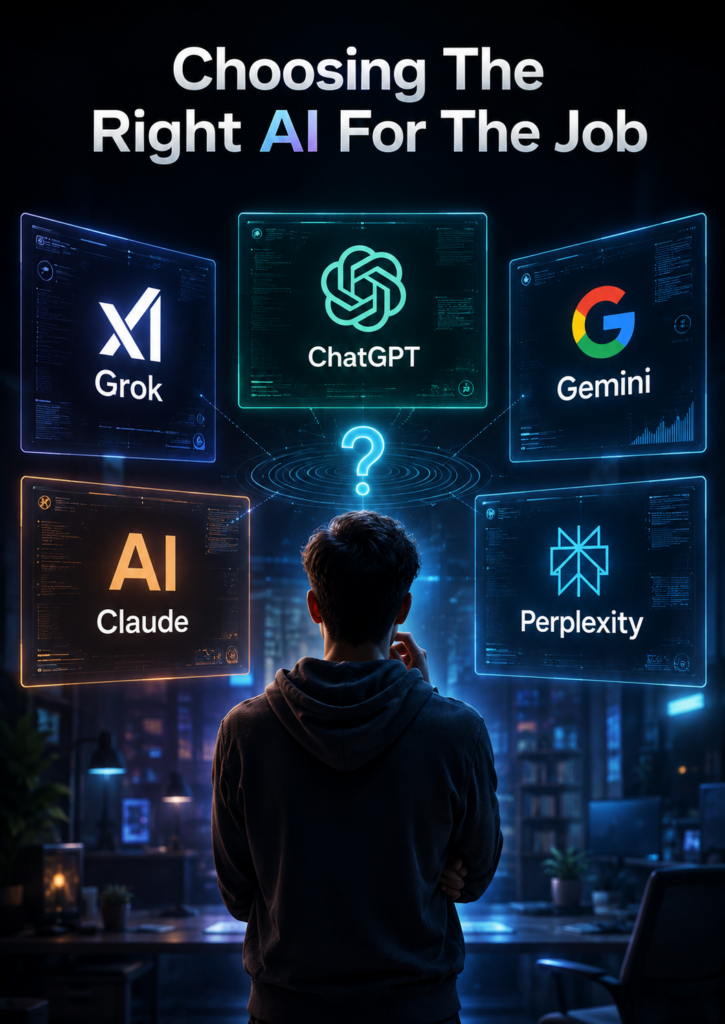

For most of 2023 and 2024, the dominant question people asked about artificial intelligence was, “Do I need AI for my Organisation?”
Now they ask, “Which Particular AI is Good for my Organisation?”
The major consumer AI platforms — OpenAI’s ChatGPT, xAI’s Grok, Google’s Gemini, Anthropic’s Claude and Perplexity have each matured into distinct tools with different data access, different reasoning styles, different integrations and different risk profiles. None of them wins every task, and independent production data studies now suggest that relying on a single model for consequential work carries a measurable structural error rate that a second model would have caught.
According to Sharad Agarwal, CEO of Cyber Gear, “Every AI LLM has strengths. Great leaders don’t chase trends, they choose the model that aligns with their vision, customers, and goals.”
This report by Cyber Gear ‘Choosing the Right AI For The Job’ reframes the conversation from model superiority to task fit. It examines each of the five leading platforms in depth, reviews the academic and industry literature on multi-agent and multi-model orchestration, and walks through real-world case studies spanning venture capital research, legal contract review, customer support, software engineering and marketing intelligence.
It also presents practical workflow diagrams that professionals and organisations can adapt to route work to the right model at the right step, along with a pricing comparison, an industry-by-industry recommendation matrix, and an honest account of the governance risks, vendor lock-in, data exposure, hallucination and “shadow AI” that come with running more than one AI system.
The evidence assembled here points to one consistent conclusion: the organizations and individuals capturing the most value from AI in 2026 are not the ones who found the single best model. They are the ones who built a repeatable process for deciding, task by task, which model to use and, increasingly, for combining several models so that one catches what another misses.
Key Finding
Across a large sample of real production conversations, more than 99% of turns in which a task was run across multiple models produced at least one contradiction, correction, or unique insight that a single-model workflow would have missed.
Financial analysis showed the highest disagreement rate among the domains tested, at roughly 72%. The practical implication is not that any one model is unreliable; it is that no single model, on its own, is a complete substitute for cross-checking on high-stakes work.
More Cyber Gear Thought Leadership Reports at https://www.cyber-gear.ae
Additional Resources: