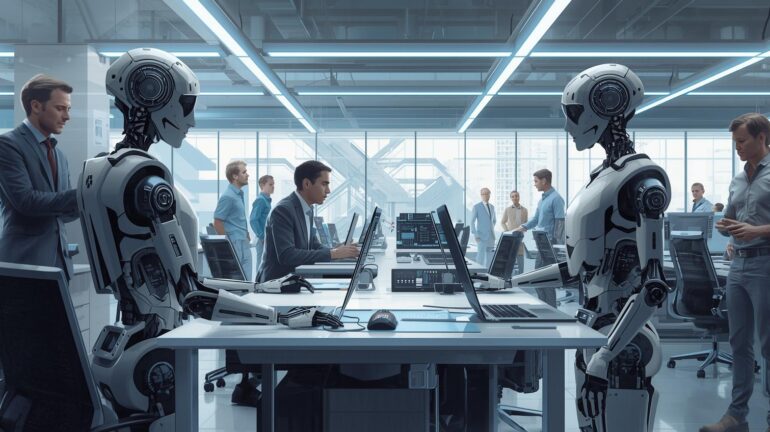

The rise of Artificial Intelligence (AI) has sparked both excitement and anxiety in equal measure. On one hand, AI promises unprecedented efficiency, productivity, and innovation across industries. On the other, it raises fears of mass unemployment, economic disruption, and a fundamental reshaping of what it means to work. As machines become increasingly capable of performing tasks once thought to require human intelligence, the question looms: will robots replace humans in the workforce?
The reality is nuanced. AI is not a monolithic force; it encompasses a wide range of technologies from robotic process automation and machine learning to natural language processing and generative AI. Each of these tools affects work differently. Many routine, repetitive tasks are already being automated. For instance, AI systems can process invoices, analyze data, and even draft reports faster and more accurately than humans. Manufacturing floors employ robotic arms that perform precise assembly tasks around the clock, while logistics companies use AI-driven algorithms to optimize delivery routes. These developments inevitably displace some jobs, particularly those involving predictable, rule-based work.
However, automation does not equate to wholesale replacement. While AI can perform certain tasks, it struggles with complex, creative, and interpersonal work. Roles that require empathy, negotiation, critical thinking, or nuanced decision-making remain difficult for machines to replicate. Healthcare professionals, teachers, designers, and leaders rely on human judgment and emotional intelligence skills that AI lacks. In many cases, AI acts as a complement rather than a substitute, enhancing human capabilities rather than eliminating them. For example, AI-assisted diagnostics help doctors make faster and more accurate decisions, but the final judgment and patient care remain in human hands.
AI is also creating new types of jobs. Demand is rising for AI specialists, data scientists, machine learning engineers, and cybersecurity experts. Beyond technical roles, entirely new career paths are emerging in AI ethics, governance, and policy, ensuring that technology is deployed responsibly. Even traditional roles are evolving; marketers now rely on AI analytics for personalized campaigns, while architects and designers leverage generative AI to explore innovative structures. In this sense, AI is reshaping the workforce rather than replacing it wholesale.
One of the key challenges lies in reskilling and workforce adaptation. As AI automates certain tasks, workers must acquire new skills to remain relevant. Lifelong learning, upskilling programs, and flexible education systems are critical to preparing employees for the jobs of tomorrow. Governments and companies are increasingly recognizing the need for strategic interventions, from vocational training to AI literacy initiatives, to ensure that technological progress does not exacerbate inequality.
AI also raises profound questions about economic and social structures. If automation continues to increase productivity while reducing labor demand, societies may need to rethink how wealth and work are distributed. Concepts such as universal basic income, shorter workweeks, and hybrid human-AI collaboration models are gaining attention as potential solutions to balance efficiency with social stability.
The future of work will likely involve human-AI collaboration rather than outright replacement. In this model, AI handles repetitive, data-driven, or hazardous tasks, while humans focus on creativity, strategy, empathy, and complex problem-solving. For example, in manufacturing, AI-powered robots can perform dangerous assembly tasks, allowing humans to focus on quality control, design improvements, and innovation. In professional services, AI can draft reports or analyze legal documents, freeing lawyers and consultants to focus on client strategy and negotiation.
Another important aspect is ethical and regulatory oversight. The deployment of AI in the workplace must be guided by principles that protect workers’ rights, ensure fairness, and prevent bias. Transparency in AI decision-making, particularly in hiring, promotions, and performance evaluations, is critical to maintaining trust and accountability. Without such safeguards, AI risks exacerbating inequality rather than promoting progress.
In conclusion, AI is transforming the future of work, but it is unlikely to replace humans entirely. Instead, it will redefine roles, create new opportunities, and reshape how work is performed. The challenge for individuals, organizations, and governments is to embrace this transformation proactively investing in skills, fostering collaboration, and designing systems that leverage the strengths of both humans and machines.
The era of AI in the workplace is not about human obsolescence; it is about human-machine partnership. Those who adapt, learn, and collaborate with AI will thrive, while those who resist may be left behind. Far from a dystopian future dominated by robots, the workplace of tomorrow promises a dynamic ecosystem where human ingenuity and artificial intelligence coexist each amplifying the other.